
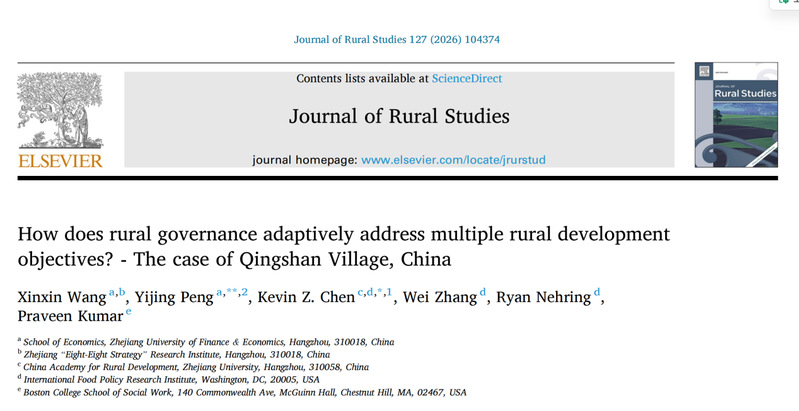
近日,浙江大学求是讲席教授、中国农村发展研究院国际院长、共享与发展研究院研究员陈志钢与浙江财经大学王鑫鑫、彭益璟,国际食物政策研究所(IFPRI)Wei Zhang、Ryan Nehring,美国波士顿学院Praveen Kumar合作论文“How does rural governance adaptively address multiple rural development objectives? - The case of Qingshan Village, China”在国际期刊 Journal of Rural Studies 在线发表。
Journal of Rural Studies(《农村研究杂志》)是乡村发展研究领域的国际顶级学术期刊,由Elsevier出版,创刊已超过40年,该刊为SSCI收录期刊、JCR Q1期刊,中科院社会学大类1区TOP期刊。目前最新影响因子为5.7,CiteScore为11.3。
该论文以浙江杭州青山村为案例,研究生态保护、经济发展与社会公平等多重发展目标并存背景下,乡村治理如何通过持续调整实现从传统层级治理向多主体协同治理转型,并进一步揭示中国乡村情境下适应性治理形成和制度化的内在机制。
文章概要
乡村可持续发展往往需要同时兼顾生态保护、经济发展和社会公平等多重目标,不同目标之间的权衡对传统治理模式提出了重要挑战。本文以浙江杭州青山村为案例,结合长期参与式田野调查、Net-Mapping和社会网络分析(Social Network Analysis, SNA),系统追踪其2003年以来不同发展阶段中政府、村集体、村民、社会组织、市场主体等多元参与者之间治理网络的演变。
研究发现,青山村的治理逐步由相对集中的层级式结构转向更加多元的协同治理体系,这一过程并非一次完成,而是依次经历问题识别与认知重构、制度化协作平台形成,以及治理边界与赋能能力重构三个阶段。
在此基础上,论文提出“嵌入式赋能(embedded enabling)”这一治理模式:在国家深度嵌入的乡村治理情境中,多中心治理并不意味着政府退出或完全去中心化,而是政府保留战略权威、合法性供给和边界设定能力,同时将具体协调和行动能力逐步赋予社区组织及其他治理主体。
这一发现拓展了适应性治理理论在中国及其他具有较强国家治理能力的发展中国家情境中的解释力,也为理解“有效政府”与“多元共治”如何形成互补关系提供了新的理论视角。
英文摘要
Adaptive governance offers a promising theoretical lens for addressing the trade-offs between ecological conservation and economic development in sustainable rural development. Yet much of the existing literature remains largely conceptual, offering high-level principles but limited insight into how adaptive governance is operationalized within real administrative systems. This study addresses this implementation gap by synthesizing a mechanism-based analytical framework and applying it to the case of Qingshan Village in China. Using Social Network Analysis combined with participatory Net-Mapping, the study traces the structural evolution of local governance across four distinct phases. The analysis shows that the shift from hierarchical to polycentric governance was propelled by the sequential activation of three mechanisms: shared problem recognition triggered by external shocks, institutionalized collaboration platforms that bridged top-down resources with bottom-up agency, and boundary-setting that redistributed enabling capacities across stakeholders. Network analysis further shows a gradual redistribution of coordination functions from governmental actors to community-based platforms, while the state retained strategic authority and enabling capacities. These findings suggest that adaptive governance in state-embedded rural contexts may emerge sequentially through cumulative processes of problem reframing, cross-sector coordination, and institutional stabilization.
原文链接
Wang, X., Peng, Y., Chen, K. Z*., Zhang, W., Nehring, R., & Kumar, P. (2026). How does rural governance adaptively address multiple rural development objectives? - The case of Qingshan Village, China. Journal of Rural Studies, 127, 104374.
DOI:10.1016/j.jrurstud.2026.104374